
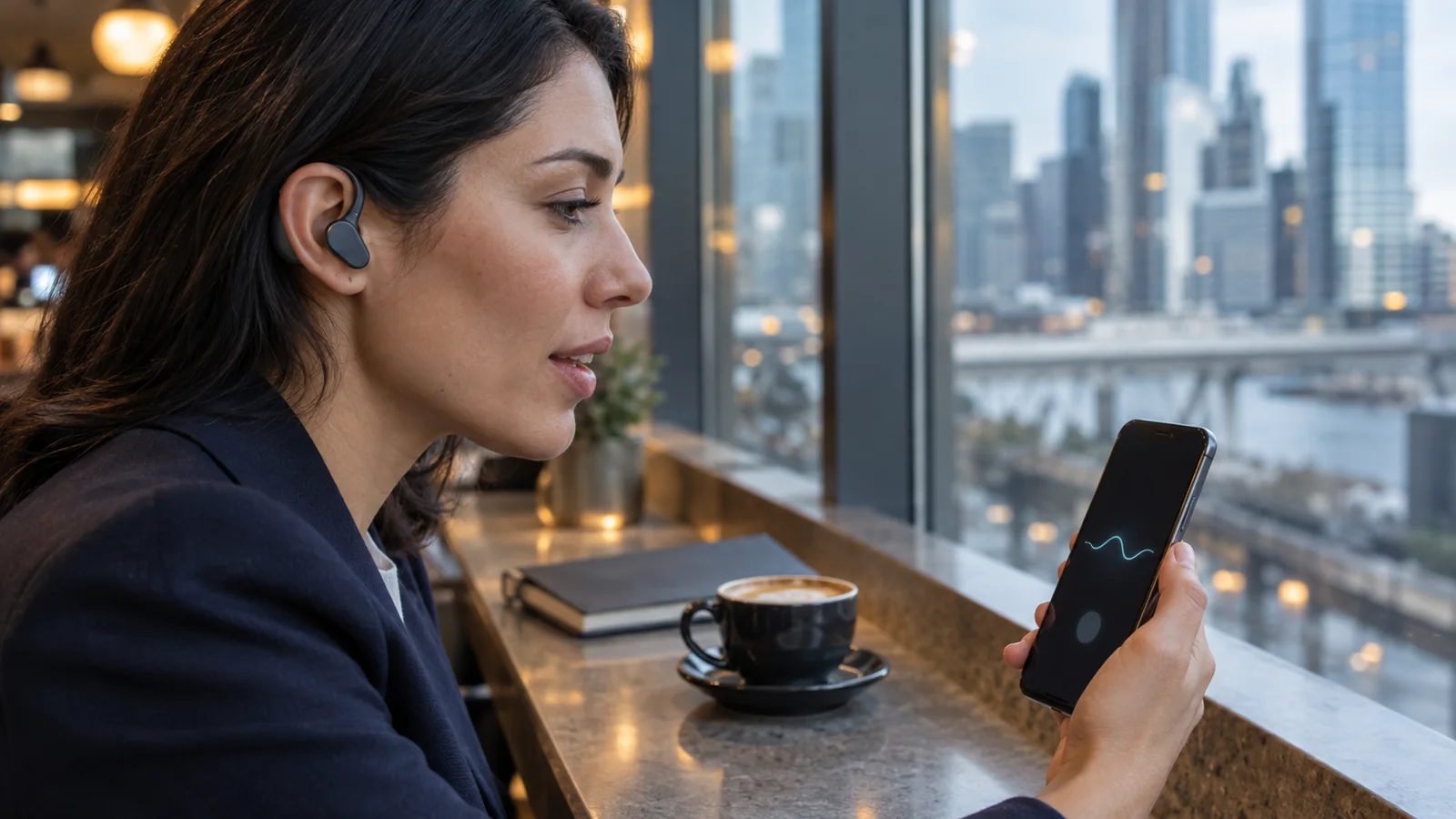
A voice task can involve both an ear-worn device and a phone. AI-generated concept scene; no specific product capability is implied.
AI earbuds can provide voice access to an assistant, translation or other software services, while also using audio processing for listening and calls. These functions do not necessarily run in the same place. To understand a specific product, check what happens in the earbuds, what requires a phone and what depends on an online service.
For a brand developing AI audio products, the most useful starting point is a user task: what can the wearer complete, with how many steps, under which conditions? The label “AI” does not answer those questions.
In this guide
Separate audio processing from an AI assistant
Two products can both advertise AI while offering different experiences.
One may use an algorithm within its audio path. Another may let the wearer speak to a phone-based assistant. A third may combine both. A noise-reduction feature does not establish that the device can retrieve information, translate a conversation or complete an action in another app.
Separate the product brief into observable functions. For a call, specify what the other person should hear. For an assistant, specify the request, the response and any action the user expects. For translation, specify the conversation setup and how each participant receives the result.
This separation also improves demonstrations. A clean voice recording demonstrates something about that recording chain under those conditions. It does not demonstrate the assistant’s accuracy or the reliability of a connected service.
What the earbuds, phone and cloud may each do
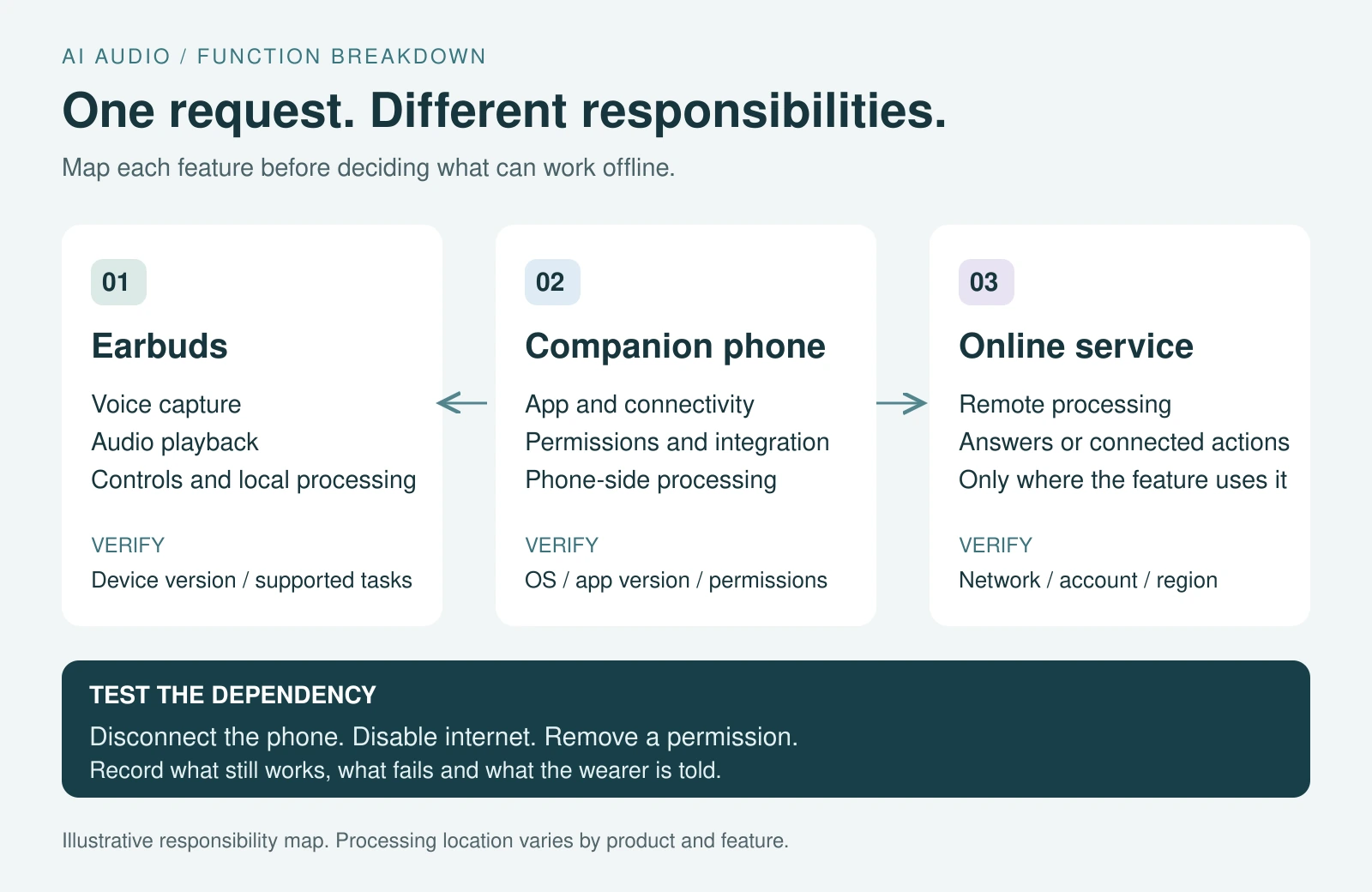
The following map is a checklist of possible responsibilities. It is not a universal architecture, and it should be completed for each proposed feature.
| Part of the system | Responsibilities to check | Evidence to request |
|---|---|---|
| Earbuds | Microphone capture, playback, controls and any local audio processing | Supported functions, control behavior and device-version information |
| Companion phone | Connectivity, app operation, permissions and integration with phone features | Supported phones, operating systems, app versions and setup steps |
| Online service | Any remote recognition, translation, answer generation or connected action | Network requirements, supported services and behavior when access fails |
For each row, ask what still works if that part is unavailable. “Works as a Bluetooth headset” and “supports every AI feature” are different compatibility statements.
A concrete example: Gemini on Pixel Buds
Google’s documentation provides a useful illustration of why feature-specific requirements matter. Its Gemini setup page lists Pixel Buds, a compatible Android phone, the relevant current apps, a Google Account, Gemini set as the default assistant and an internet connection. The page describes hands-free assistance, including requests involving information and supported apps. Google: Use Gemini on Pixel Buds
That establishes a connected experience. It does not establish that the earbuds independently run the complete assistant, or that pairing them with any Bluetooth device enables the same functions.
For a competing product brief, the useful lesson is to make dependencies visible before development or purchase. Check the current support information for the specific product, region and language instead of borrowing requirements from another brand.
Do AI earbuds work without a phone?
There is no reliable category-wide yes or no. Start with the feature you want to use.
Music playback, microphone operation, an assistant request and a translation task can have different requirements within the same product. A feature described as offline should identify exactly which task works offline, which software or language resources must already be installed, and which connected device is still required.
Use a feature-by-feature record:
| Intended task | Questions that resolve the dependency |
|---|---|
| Listen to audio | Where is the audio stored or streamed? Which device supplies playback? |
| Ask a question | Where is the request processed? Is a phone, account or network required? |
| Translate speech | Which devices do both people need? Which language pair and modes are supported? |
| Create a reminder | Which app stores it? How does the user confirm it was saved? |
| Retrieve a note | Where is it stored? What access and connectivity are needed? |
These are evaluation questions, not claims that every AI earbud supports the listed tasks.
Judge usefulness by the task that gets completed
Consider a person who wants to capture a short reminder while their hands are occupied. A useful demonstration follows the complete task: activate the feature, say the request, receive confirmation and find the saved result later.
Count the manual steps and interruptions. Does the wearer need to unlock the phone? Repeat the request? Open an app to finish? Is an unsuccessful action clearly distinguished from a successful one?
For health audio and older-user products, also check whether the controls and prompts fit the intended person. Voice access can offer another way to interact, but a voice feature should not be assumed to remove every usability barrier. A dependable physical control or clear phone interface may still be needed.
This is where a brand can create a useful product brief: one valuable task, its expected result and the circumstances in which it must work.
Test failures as carefully as successful demonstrations
Before approving a feature, define a small set of relevant conditions and repeat the same task. Keep the hardware, software and service versions in the record.
- Normal connection: confirm the complete task and its result.
- No internet: record what remains available and what message the user receives.
- Phone unavailable: check behavior when the phone is out of range or disconnected.
- Permission unavailable: establish whether the user receives an understandable next step.
- Interruption: check what happens when a call or another audio source interrupts the task.
- Recovery: restore the missing condition and check whether the user can resume normally.
Choose the conditions that apply to the actual feature. Do not turn this checklist into a claim that every product has passed these checks.
If a task records or sends speech to a service, document when recording starts, how it is indicated, where the data goes and how users can manage it. Use the service’s current documentation to verify those answers; “AI-powered” is not a privacy explanation.
Measure battery life and delay in the mode being sold
A music-playback figure cannot, by itself, establish endurance during repeated assistant use. For a proposed test, record audio mode, volume setting, microphone activity, request frequency, network conditions and software versions. Report earbud endurance separately from extra charges available in the case.
Likewise, name the delay being measured. Time from a spoken request to a useful answer is a different measurement from an audio-path delay. A single number without a defined start, end and test condition gives a buyer little basis for comparison.
A brand does not need to invent a complex benchmark first. It needs a repeatable task and an honest description of the conditions under which the result was obtained.
Turn the idea into a development brief
Before asking for a quotation, write down the primary user, one priority task, required phones and languages, intended service, controls, failure behavior and acceptance method. Mark which responsibilities belong to the hardware team, the app team and the service provider.
ALOVA’s focus is open-ear health audio and OEM/ODM development for brands. For an AI audio concept, hardware needs and any app or service integration should be evaluated together for the proposed project; assistant or translation capability should not be assumed from the headphone category alone.
Have an AI audio use case in mind? Share the task and operating conditions with ALOVA. A clear task is the starting point for evaluating the hardware experience and the integration it needs.