
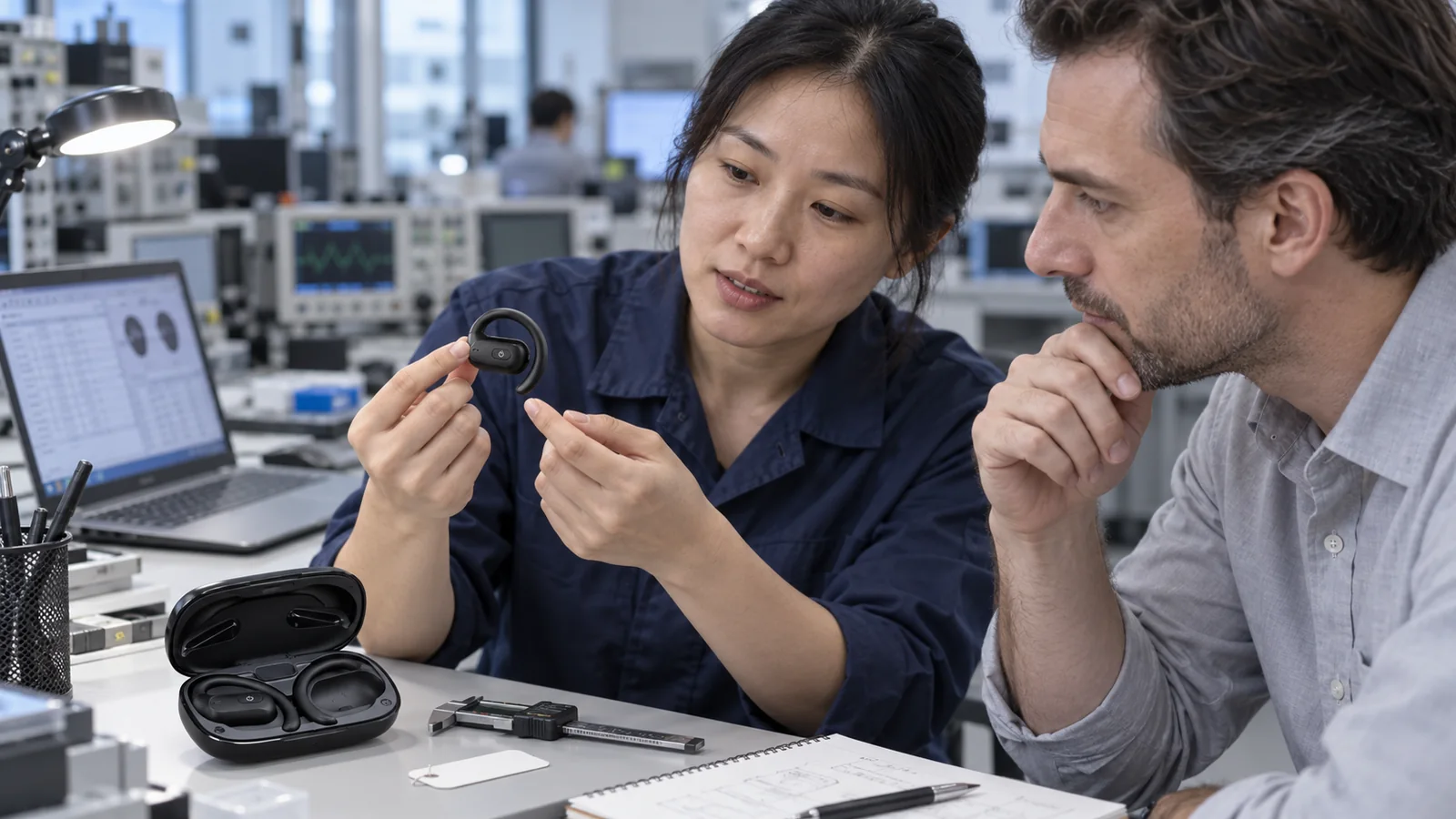
Sample-review scenario: align the physical unit, requirements and supporting records. AI-generated illustration.
Choose an open-ear headphone ODM by reviewing evidence tied to your intended users, the actual sample version and the proposed production process. Before committing to tooling or volume, agree on requirements, test methods, acceptance criteria and change control. A convincing demonstration starts the evaluation; it does not complete it.
This checklist helps brand owners, product managers and procurement teams turn a supplier conversation into a set of reviewable decisions. It applies to the development process, without assuming that one design, test plan or commercial arrangement suits every project.
In this guide
1. Define what the product must do for its user
A request for “comfortable open-ear headphones with good calls and long battery life” leaves the important choices unresolved.
Describe the person, activity and environment first. Will the wearer use glasses? Are calls a main activity or an occasional feature? Which phone and controls will they use? How will they charge the device? Which market and sales channel will receive it?
Then separate required outcomes from preferences. A required control, a target wearing experience and a preferred finish do not have the same role in a design decision. Record the priority order before comparing proposals.
Ask for: a written product brief with requirements, open questions, an owner for each question and the evidence needed to close it.
Look for: an explanation of how the proposal addresses the brief, including trade-offs. A change that improves one requirement can create a new question elsewhere; the proposal should make that visible.
2. Identify the sample you are actually approving
A sample is useful evidence only when its configuration is known.
Ask for a sample identifier, hardware revision, software version, relevant components and a list of any temporary parts or incomplete functions. A hand-built prototype and a unit produced through the intended assembly process answer different questions.
If a demonstration uses a temporary battery or a different software build, record that difference beside the result. Do not let a target in a product definition become a measured specification through repetition in presentations.
Ask for: a sample configuration sheet and a change log between the demonstration unit and the next version.
Look for: a clear distinction between a design target, an observed result and an approved specification. Where evidence is still missing, agree on the next test and the decision it will support.
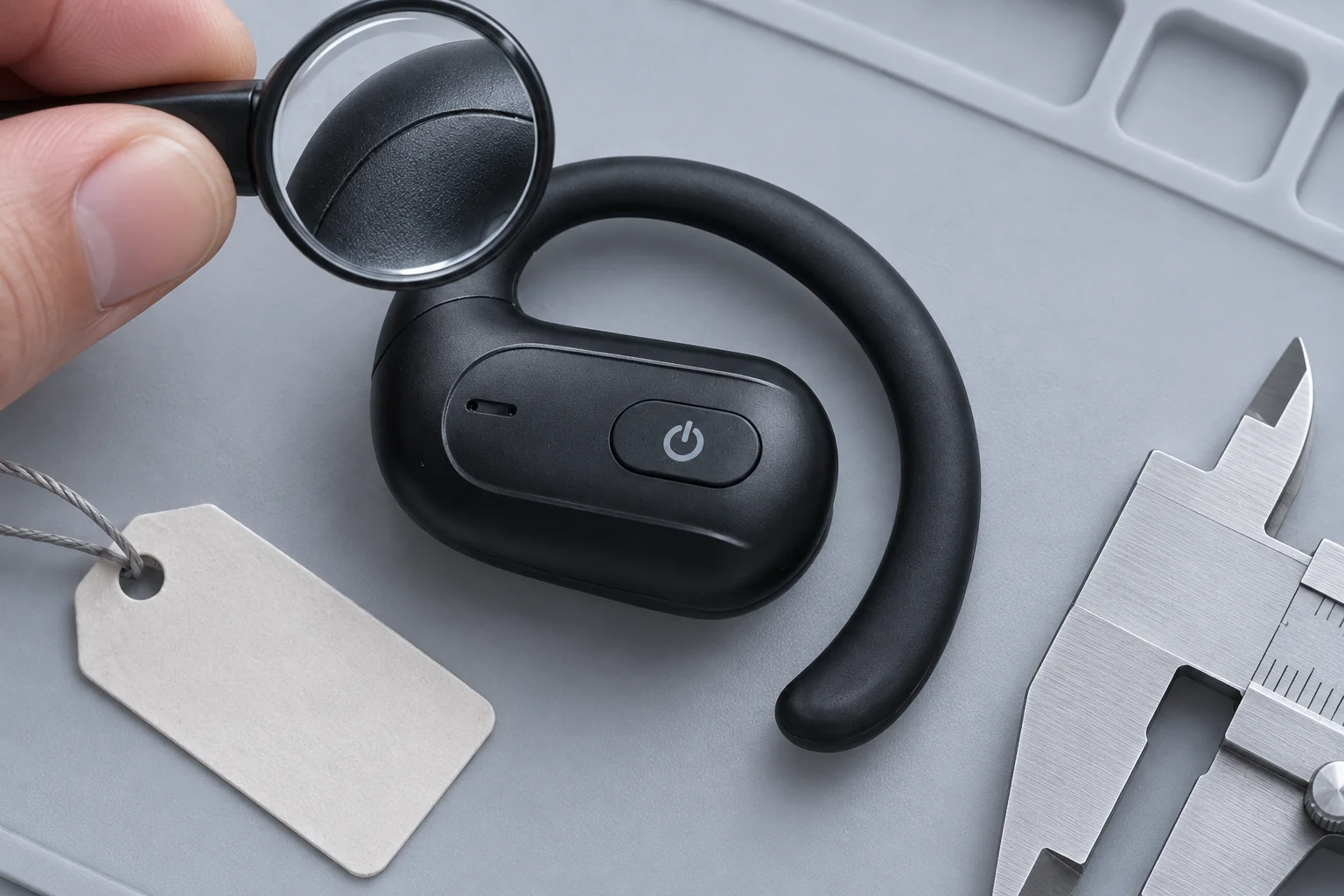
Inspect finish and joint consistency against the approved exterior specification.
Review accessibility and symbols, then verify operation on the actual sample.
Record sample ID and revision; request separate measurements and functional evidence.
3. Evaluate the experience under relevant conditions
For open-ear products, the wearer and the setting belong in the evaluation. Use the intended tasks to choose what to test.
| Area | Evidence to request | Details that make it interpretable |
|---|---|---|
| Fit and comfort | A structured wear review | Participant characteristics relevant to fit, glasses, activity, duration and feedback |
| Call quality | Recordings or a documented call test | What the far end receives, noise setting, devices, network and software version |
| Battery endurance | A report for the advertised mode | Battery and sample version, mode, volume, enabled features and end condition |
| Sound leakage | A defined listening or measurement setup | Playback content, level, distance, direction and background sound |
| Controls and charging | Task observations and functional checks | Expected feedback, accidental actions, connection state and recovery behavior |
An audio demonstration should identify the recording chain and any processing applied after capture. A fit review should report what participants actually did and said. Keep observations separate from broad claims about a technology category.
Ask for: the method alongside the result, including conditions that were not tested.
Look for: enough detail to repeat the relevant comparison. The goal is to understand the evidence, rather than to collect the largest folder of reports.
4. Connect reliability evidence to the specific product
A photograph of a test machine does not establish that the proposed product passed a particular test. A report from another model does not automatically cover a new enclosure, connector, battery or assembly process.
Request the report identity, test item, sample configuration, method, acceptance criterion, result and any failure or retest record. If a report is being used to support a market-access claim, verify its scope with the responsible compliance specialist for that product and market.
ALOVA’s published quality-control overview describes checks across materials, assembly, functions and finished products. That overview is a starting point for discussion; the applicable methods and evidence should be identified for the project under review.
Ask for: a project-specific validation plan and the corresponding completed records at the agreed stage.
Look for: a traceable connection between the claim, the tested configuration and the configuration that will be supplied.
5. Review production readiness separately from sample performance
A working sample answers whether that sample works. Production review asks how the intended result will be repeated and checked.
Ask which assembly steps require fixtures or controlled instructions, what operators inspect and how the team handles a failed unit. Review the planned checks for incoming parts, assembly, finished units and packaging at a level relevant to the project.
Use a pilot or initial production stage to examine the proposed process. Define what will be recorded, who reviews deviations and what prevents unresolved issues from being carried forward. Avoid treating an agreed shipment date as evidence that technical questions have been closed.
Ask for: the relevant work instructions, inspection plan, pilot findings and unresolved-issue list.
Look for: a named owner and a closure method for each issue. “Fixed” should identify the change and its verification, rather than end the record.
6. Agree how later changes will be controlled
A project can change after a promising evaluation. Components, software, tooling, packaging and instructions may all be revised.
Specify which changes require notification or approval, which evidence must be repeated and how versions will be identified. Include app and phone compatibility if they affect the product. The support instructions should match the version the customer receives.
Commercial scope belongs in the same discussion. Confirm the responsibilities for development work, tooling, validation, software, packaging and after-sales support. Request assumptions behind a quotation, including quantities and dependencies. A headline unit price cannot explain the whole commitment.
Ask for: a written change-control process and a quotation with a clear scope.
Look for: agreement on who decides, what evidence is required and which version is approved.
A compact record for the approval meeting
Use the following fields for each requirement. Keep the record with the sample and the revision history.
| Field | What to enter |
|---|---|
| Intended result | The user or product requirement being reviewed |
| Evidence | Report, recording, observation or other source and its location |
| Configuration | Sample identifier, hardware and software version |
| Conditions | How, where and for how long the evaluation was performed |
| Outcome | Observation and whether the agreed criterion was met |
| Remaining work | Unanswered question, owner, next action and review point |
| Decision | Accepted for this stage, revise and retest, or hold |
These decisions apply to a defined stage. Accepting a prototype for further development is different from approving a specification for production.
Start the supplier discussion with your brief
ALOVA’s ODM development process includes design, design verification, production verification and production stages. For a new project, use those stages to ask what decision each piece of evidence supports and what still needs to be demonstrated.
Planning an open-ear headphone project? Send ALOVA your intended users, use case and priority requirements. Include the evidence you need for a decision, so the discussion can address development scope and verification from the start.