
Alova · OEM/ODM insights
F8 + F2FA brings a distant talker to the listener. F30 + F2FA brings television audio to the listener. Both transmitters support one-to-many reception over a wireless distance of up to 15 metres.

The direct answer: Alova presents two configurations for evaluation: F8 + F2FA for remote voice pickup, and F30 + F2FA for TV listening. Either transmitter can send its audio to multiple compatible F2FA receivers, with no fixed receiver-count limit specified in the product configuration and a wireless transmission distance of up to 15 metres. Actual coverage depends on the environment.
The opportunity for brands: Build a modular listening range around familiar wearing controls: a conversation kit, a TV kit, and a combined home kit. Its commercial value depends on usable switching, proven compatibility, comfort and support—not simply including more accessories.
01 · Start at the source
Two listening frustrations, two different audio paths
A family member turns up the television. Someone else turns it down. Later, the same listener asks a person across the table to repeat a sentence. Both experiences involve listening, but the useful source is in a different place.
For television, the source is an electronic audio output. For conversation, it is a person’s voice. A headset alone does not determine how well either source reaches the listener. The complete path—from source, through transmission, to the receiving headset—matters.

A remote microphone puts pickup closer to the talker and sends that signal to a compatible receiver. A TV transmitter takes an audio feed from the television or another supported source and sends it to the receiver. These are complementary ways to bring a selected source closer to the listener. [1]
Neither approach guarantees that every word will be understood. Competing talkers, microphone handling, room conditions, individual hearing needs and the receiving device all affect the outcome. Choosing the right source is the starting point for validation.
02 · Two solutions, one receiver family
F8 for remote pickup. F30 for television.
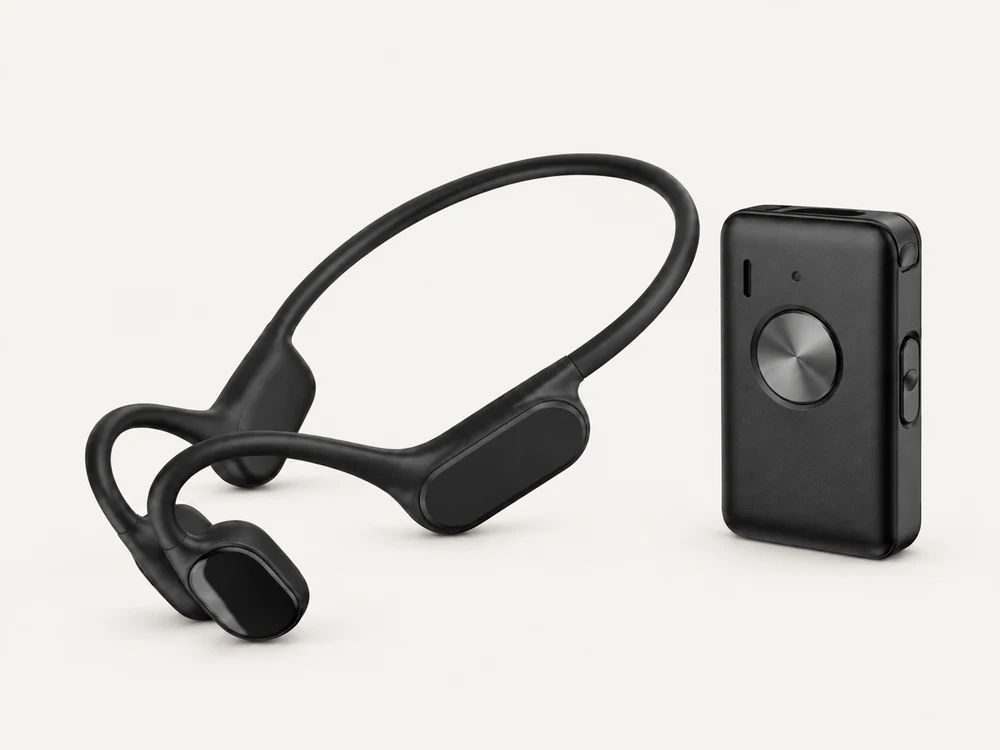
The two transmitters address different sources. F8 picks up a person’s voice near the talker; F30 accepts audio from a television or supported audio device. Each sends its selected source to compatible F2FA bone-conduction receiving headsets through the 2.4 GHz system.
| Solution | Problem it addresses | How it works |
|---|---|---|
| F8 + F2FA Remote voice pickup | The listener is separated from the person speaking | Place F8 near the talker. F8 captures the voice and transmits it to the listener’s F2FA, so pickup does not depend only on a microphone at the listener’s position. |
| F30 + F2FA TV listening | The listener needs personal television audio rather than relying only on the room speakers | Connect F30 to a supported TV/audio output. F30 transmits the electronic audio feed to F2FA. |
Solution 1: F8 remote-pickup listening
F8 is useful when the speaker and listener are apart: a family conversation across a room, a small presentation, or a caregiver explaining something from a different position. The transmitter goes near the speaker; the compatible receiver stays with the listener.
The product configuration supports a wireless transmission distance of up to 15 metres between transmitter and receiver. This is the radio-link distance, not a claim that the microphone captures clear speech from 15 metres away. Good microphone placement remains essential.
Solution 2: F30 television listening
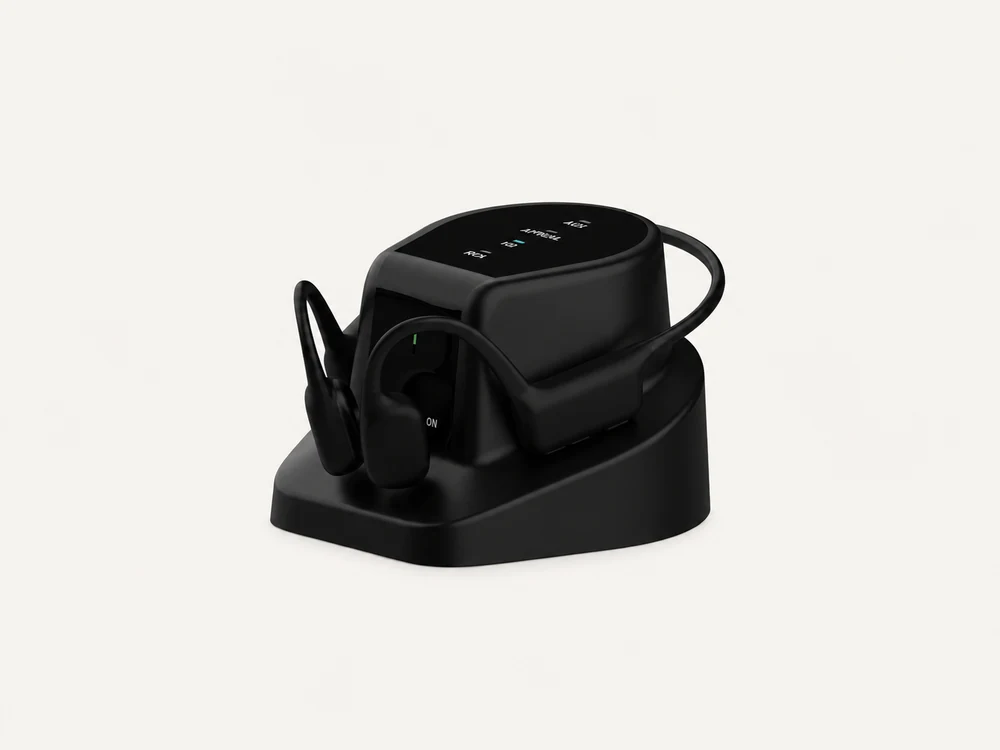
F30 takes television audio through its supported inputs and sends it to the receiving headset. The V1.0 development definition lists HDMI ARC/eARC, optical, coaxial and AUX inputs; USB-C is also described for power/data. Audio formats and each target TV’s settings must match the delivered configuration.
One transmitter, many receivers—in either solution
Both F8 and F30 support one-to-many reception: one transmitter can supply the same audio source to multiple compatible F2FA receivers. According to Alova’s product confirmation, this configuration has no fixed receiver-count limit. It can therefore serve several listeners without requiring a separate transmitter for each person.
For a brand, that creates configurations beyond a single-user kit: one speaker with several listeners, one TV with several receiving headsets, or a household package containing both transmitter types. The up-to-15-metre wireless range applies to the transmitter-to-receiver link; walls, interference and installation affect actual coverage. “No fixed receiver-count limit” does not mean unlimited coverage or guaranteed performance in every installation.
03 · From the living room to conversation
Make daily participation the product story
Shared television, personal listening
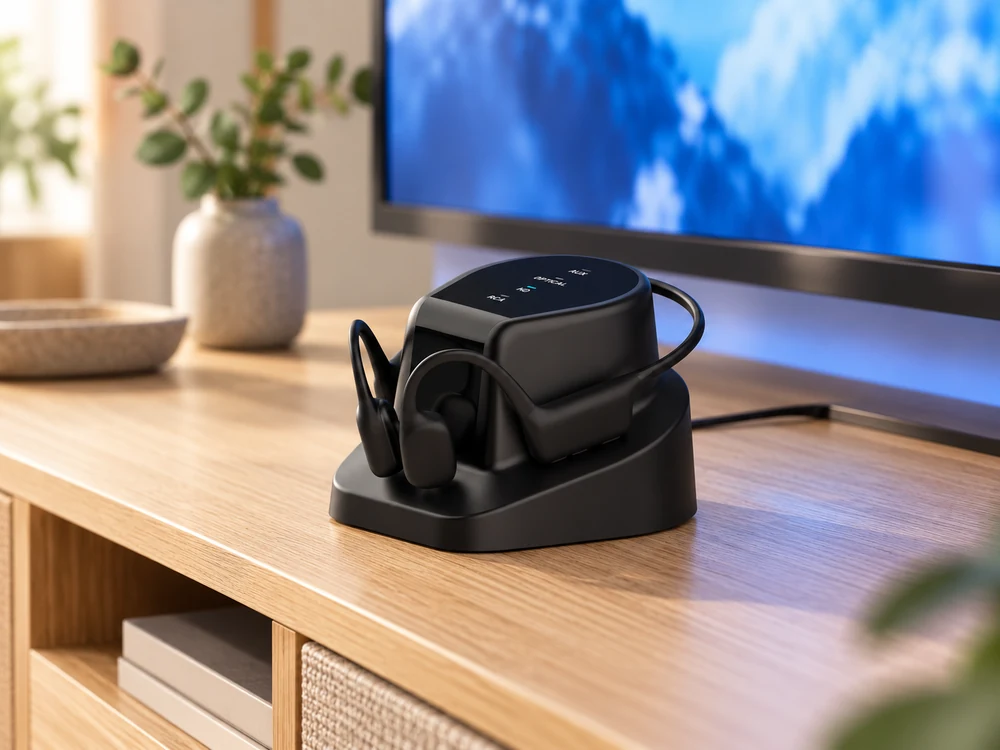
A TV listening kit can let one person receive television audio through a headset while family members continue using the room speakers—where the television and connection support both outputs. RNID identifies this as an important use of TV listeners. [2]
For a brand, the useful promise is a verified household setup. It should show the correct TV socket, required setting and volume controls. A connector list alone cannot confirm that the TV speaker will remain active or that its volume will be independently adjustable.
A clearly explained base location also gives the system a familiar home. The supplied render shows a headset placed around the base; charging behaviour should be confirmed before marketing it as an automatic charging dock.
A portable source for one-to-one exchanges
F8 extends the system beyond television through remote pickup. A family member, presenter or conversation partner can position it near their voice, within the agreed usage instructions. The listener uses the compatible headset rather than moving the microphone with their own head.
This is best presented first as a defined one-talker use case. A microphone placed in the middle of a busy room does not automatically select the person the listener wants to follow. Small-group performance needs separate evaluation, including turn-taking and placement. UCSF highlights these practical limitations for remote microphones. [1]
The open-ear format leaves the ear canal unblocked. That wearing characteristic is not a guarantee of speech understanding, awareness of every surrounding sound or suitability for a particular degree of hearing loss. Individual suitability must be assessed separately.
04 · The brand opportunity
A listening range built around recurring situations
The broad need is substantial: WHO projects that nearly 2.5 billion people will have some degree of hearing loss by 2050. This is population context, not the addressable market or expected demand for this product. It does not establish who can benefit from F2FA or who will buy a kit. [3]
The more actionable opportunity is a focused proposition: make two frequent listening situations easier to set up and use within a compatible product family. The following are commercial hypotheses for brands to test, not reported sales results.
| Potential offer | Customer need | What would justify it |
|---|---|---|
| TV starter kit: F30 + F2FA | Personal TV audio in a shared household | Easy installation on target TVs and a comfortable viewing trial |
| Remote-pickup kit: F8 + F2FA | A selected talker delivered to a personal receiver | Useful real-world performance and clear microphone etiquette |
| Combined home kit | Both situations without learning two different headset designs | Simple source selection, clear packaging and manageable total cost |
| Additional compatible receiver | Several listeners sharing the F8 voice source or F30 TV source | Suitable coverage, receiver adjustment and stable operation in the target installation |
Three routes to evaluate
Specialist home-audio brands can start with TV listening and test whether an optional conversation transmitter adds useful demand. Independent-living and senior-focused retailers can demonstrate the whole household workflow, including setup by a family member. Hearing-care channels can evaluate the system’s role only within appropriate intended-use, suitability and regulatory boundaries.
A common receiver design may simplify demonstrations, instructions and accessory expansion. It can also create support complexity: wrong input selection, forgotten pairing, power confusion and expectations of universal compatibility. Brands should measure those costs before treating a larger bundle as a better business.
Existing alternatives also matter. TV dialogue settings, captions, compatible hearing-aid streamers and conventional TV headphones may already meet a customer’s needs. The combined offer earns its place when the customer needs both use cases and finds the complete workflow easier or better suited to their situation.
05 · Before an OEM/ODM launch
Validate the experience behind the bundle
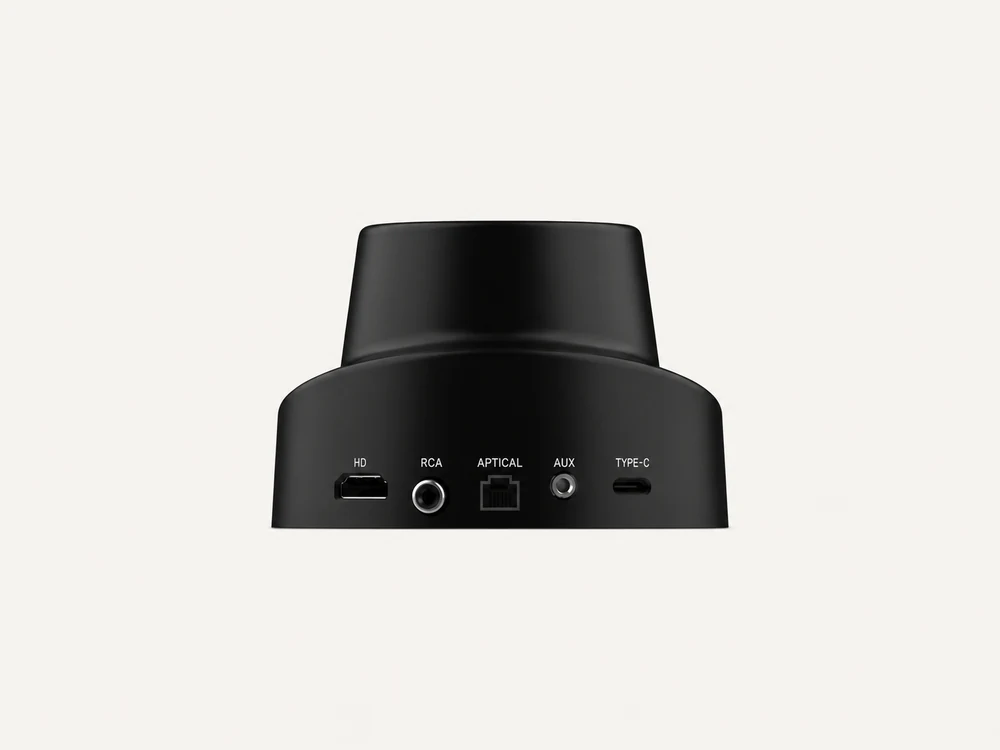
The strongest buying decision comes from a sample plan tied to actual scenarios. Avoid approving the product solely from a render, chipset description or isolated wireless-delay claim.
TV path: Test representative television brands and connection types, audio settings, lip synchronisation, power cycles and the behaviour of the television speakers. Measure the full path under stated conditions.
Conversation path: Try quiet and competing-speech settings, different microphone placements, handling noise and talker changes. Record practical benefit and failure conditions rather than assuming processing will solve every environment.
Whole-system use: Observe first setup without coaching, source changes, recovery from incorrect input selection, receiver adjustment and repeated daily use. Confirm whether switching is manual or automatic, and whether users can understand the active source.
Commercial readiness: Verify the intended multi-listener installation, up-to-15-metre coverage, runtime, charging and power behaviour, sample acceptance, packaging, accessories, support responsibilities and market-specific compliance documentation. None of those should be inferred from the illustrations.
The decision for brand partners
The combination is worth evaluating when a target customer has both a television-listening need and a selected-talker need, and a shared headset makes those situations simpler. The next step is a defined trial with representative users and target equipment. A successful range grows from evidence of useful daily participation and a workable support model.
Questions from brand buyers
Can the same headset be used for television and conversation?
F2FA can receive from either the F8 remote-pickup transmitter or F30 TV transmitter. Each transmitter supports multiple compatible receivers with no fixed receiver-count limit specified for this configuration, over a wireless distance of up to 15 metres, subject to the environment. Confirm the delivered firmware, pairing and source-selection behaviour. The materials do not establish simultaneous audio mixing or seamless automatic switching.
Will F30 work with every television or hearing device?
No universal compatibility is established. Its defined inputs broaden connection options, but the television’s output, supported audio formats and settings must match. The proprietary link is specified for compatible F2FA receivers, not arbitrary Bluetooth headsets or hearing aids.
What is the practical market opportunity?
A modular range can address TV-only, conversation-only and combined household needs around a shared receiver. Brands should validate target-user fit, setup success, willingness to pay and support costs before forecasting demand or expanding the range.
Discuss your listening-system project
Start with the people and situations you want to serve
Share your intended users, priority listening scenarios, target markets, TV interfaces, required receiver count, estimated quantities and timing. Alova can use that brief to discuss the proposed OEM/ODM configuration and the evidence needed for evaluation.
Discuss a project with Alova →