
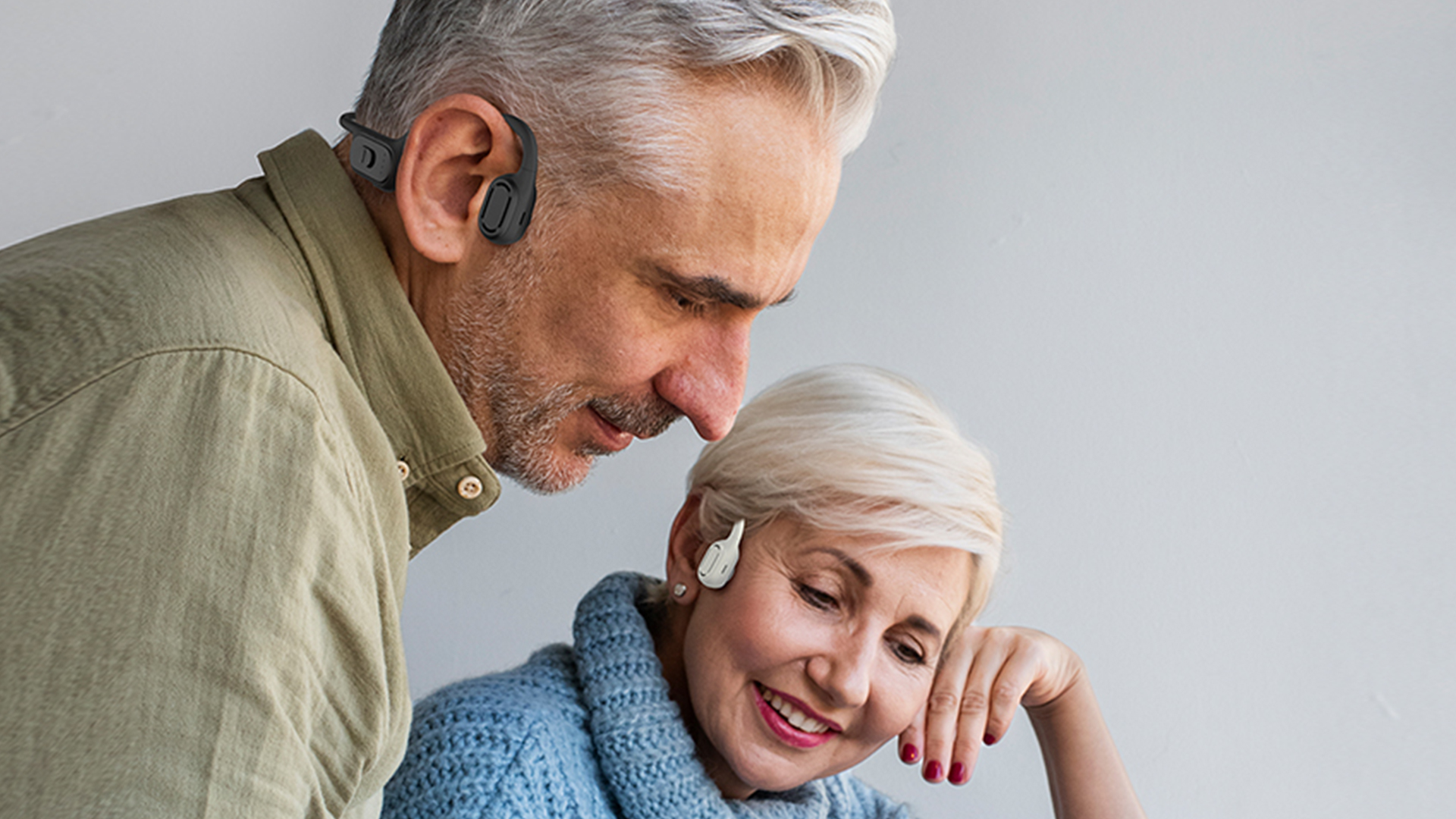
Many people want clearer conversations, but traditional hearing aids can feel too medical, too visible, or too hard to accept.
Open-ear assistive listening is becoming a new non-medical hearing support trend because it meets a real market gap between traditional hearing aids and daily consumer audio products.
It does not replace professional hearing aids, but it gives users a lighter, more comfortable, and more lifestyle-friendly way to support daily conversations, TV listening, family communication, and environmental awareness.
Recent crowdfunding success in Japan has made this signal clearer.
A lightweight ear-worn assistive listening product gained more than 10,000 supporters before the campaign ended.
Its funding also went far beyond the original target.
This shows that the demand for comfortable, non-medical hearing support is not only a product idea.
It is already being tested and confirmed by real consumers.
For elderly care channels, assistive listening distributors, large retail buyers, and global buyers in Japan, Korea, Europe, and North America, this category is worth serious attention.
Why Does Japan’s Crowdfunding Success Matter?
The Japanese crowdfunding case matters because it shows real user demand before wide retail launch.
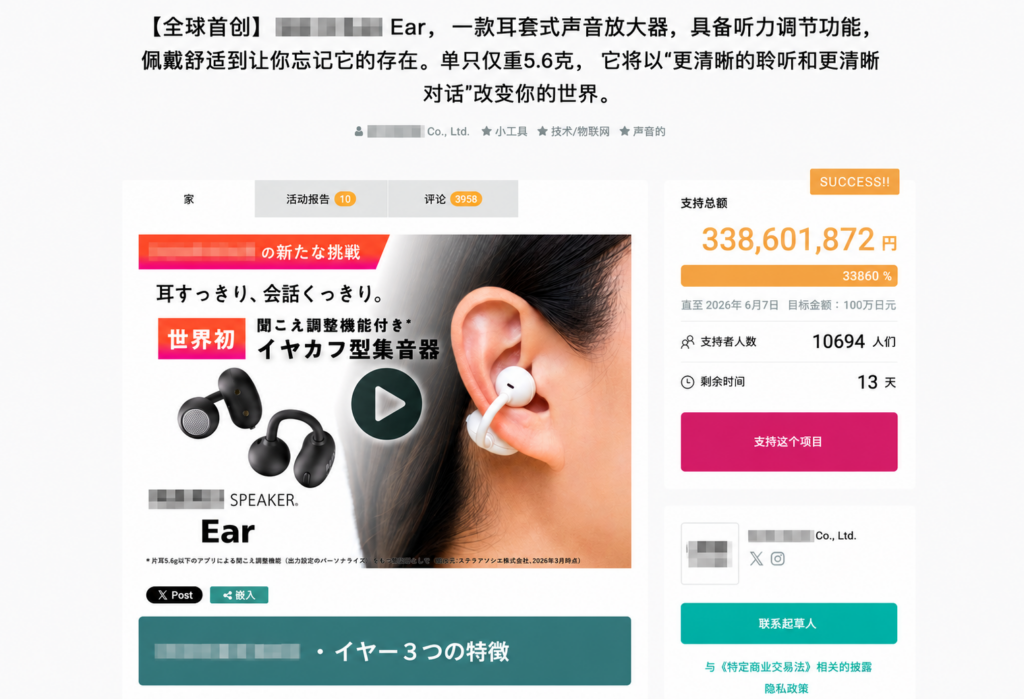
A recent Japanese crowdfunding campaign for a lightweight ear-worn assistive listening product attracted more than 10,000 supporters before it ended.
This proves that users are not only curious about open-ear hearing support; they are already willing to support and pay for products that feel lighter, more comfortable, and less medical.
Many new product categories look attractive when they are shown as ideas.
But ideas do not always become real market demand.
A beautiful concept image, a good product story, or a new wearable form can catch attention.
But attention is not the same as willingness to pay.
Crowdfunding is useful because it gives the market a more direct signal.
When users support a product before it reaches normal retail channels, it means the product has touched a real need.
In this case, the product was not a traditional hearing aid.
It was a lightweight ear-worn sound amplification product with hearing adjustment features.
It was positioned closer to daily listening support than clinical hearing care.
This is exactly why the result matters.
It shows that some users want hearing help, but they may not want a traditional medical-looking hearing aid.
They may want something smaller.
They may want something easier to wear.
They may want something that looks closer to consumer electronics.
They may want a product that helps them hear conversations clearly without making them feel old, sick, or different.
For B2B buyers, this is not just a story about one successful campaign.
It is a market signal.
| Crowdfunding Signal | Market Meaning |
|---|---|
| More than 10,000 supporters before the campaign ended | Strong early user interest |
| Funding far above the original target | Real willingness to pay |
| Ear-worn assistive listening form | Users are open to new wearing styles |
| Lightweight product positioning | Comfort is becoming a key buying reason |
| Hearing adjustment function | Daily sound support is a real user need |
| Strong response before mass retail | Category potential is being validated early |
The most important lesson is not to copy one product.
The deeper lesson is that users are showing interest in a new type of hearing support.
This type of product is not trying to replace professional hearing aids.
It is opening a new daily hearing support space for users with mild listening difficulty, family communication needs, and aging-related sound awareness needs.
That is why open-ear assistive listening deserves attention now.
What Is Open-Ear Assistive Listening?
Open-ear assistive listening is a non-medical hearing support product direction that helps users hear daily sounds more clearly while keeping the ear canal open.
Open-ear assistive listening products are designed for daily sound enhancement, not medical hearing treatment.
They can support family conversations, TV watching, community communication, outdoor awareness, and elderly care environments while offering a more comfortable wearing experience than many traditional in-ear products.
Open-ear assistive listening sits between traditional hearing aids and consumer audio products.
It is not the same as a professional medical hearing aid.
It is also not only a normal headphone.
Its value is daily hearing support.
Many users do not need a full medical hearing solution in every daily situation.
They may only need help hearing family members more clearly.
They may want to watch TV without turning the volume too high.
They may want to hear a caregiver, a doorbell, a phone ring, or someone speaking nearby.
They may want to stay aware of traffic or public sounds when walking outside.
This is where open-ear assistive listening can create value.
The open-ear structure is important because it keeps the ear canal more natural.
It reduces the blocked-ear feeling.
It helps users stay aware of their surroundings.
It also makes long-time wearing easier for some users.
This is especially important for elderly users.
A product that looks useful but feels uncomfortable may not be used every day.
A product that feels light, simple, and acceptable has a better chance to become part of daily life.
| Daily Use Scenario | User Need | Product Value |
|---|---|---|
| Family conversation | Hear speech more clearly | Supports daily communication |
| TV watching | Avoid turning TV volume too high | Improves personal listening comfort |
| Outdoor walking | Hear people and surroundings | Keeps environmental awareness |
| Elderly care | Improve communication with caregivers | Supports care efficiency |
| Community activity | Follow conversations better | Helps social participation |
This is why open-ear assistive listening is not only a product form.
It is a response to a real user problem.
Users want better hearing support.
But many also want comfort, dignity, simple use, and a product that feels normal in daily life.
Why Are Users Looking Beyond Traditional Hearing Aids?
Many users do not reject better hearing; they reject the pressure that can come with wearing a traditional medical device.
Users are looking beyond traditional hearing aids because the decision is not only about sound improvement.
It is also about appearance, comfort, price, ease of use, emotional acceptance, and whether the product can fit into normal daily life without making the user feel old or sick.
Traditional hearing aids remain essential.
They support users with diagnosed hearing loss.
They often require hearing tests, professional fitting, and regulated sales channels.
For users with clear medical hearing needs, this path is necessary.
But the market also includes another large group.
These users may have mild daily hearing difficulty.
They may miss some words during family conversations.
They may ask people to repeat themselves.
They may need a higher TV volume.
They may find group conversations harder than before.
They may hear sound but not understand speech clearly in some scenes.
But they may not be ready to wear a traditional hearing aid.
This is where psychology becomes important.
Some users see hearing aids as a sign of aging.
Some worry that other people will notice.
Some think hearing aids are too expensive.
Some feel the fitting process is too complicated.
Some only need support in certain daily scenes, so a full medical solution may feel too much.
Open-ear assistive listening answers this gap in another way.
It can look closer to consumer electronics.
It can be explained as daily hearing support.
It can feel less medical and more lifestyle-friendly.
This makes it easier for some users to try.
| User Concern | Traditional Hearing Aid Barrier | Open-Ear Assistive Listening Direction |
|---|---|---|
| Appearance | May feel medical | Can look more like a wearable device |
| Comfort | May block or fill the ear | Keeps the ear canal open |
| Price | Often higher | Can offer a more accessible option |
| Use process | May need professional fitting | Can be easier for daily use |
| Psychology | May signal aging | Can feel more lifestyle-based |
| Use case | Focused on clinical hearing needs | Focused on daily sound support |
This does not mean open-ear assistive listening should replace hearing aids.
It means the market needs more than one type of hearing support.
Some users need professional medical hearing care.
Some users need daily sound enhancement and easier conversations.
For buyers, this difference is important.
The new opportunity is not only in users who already buy hearing aids.
It is also in users who need help but have not entered the traditional hearing aid market.
Why Does Open-Ear Design Improve User Acceptance?
Open-ear design improves user acceptance because it makes hearing support feel lighter, less blocked, and more natural.
Open-ear design keeps the ear canal open, which can reduce pressure and blocked-ear feeling.
It also helps users stay aware of surrounding sounds, making the product more suitable for daily conversation, outdoor movement, family care, and elderly care environments.
Comfort is not a small detail in assistive listening products.
It decides whether users will keep wearing the product.
A product may have useful sound enhancement.
But if it feels heavy, tight, blocked, or hard to operate, users may stop using it quickly.
This is common in assistive products.
The first purchase does not prove success.
Daily use proves success.
Open-ear design helps reduce some common barriers.
It keeps the ear canal open.
It can reduce pressure.
It allows environmental sounds to remain present.
It also makes the product feel closer to a daily wearable device.
For elderly users, this matters.
They may want to hear family members more clearly.
But they also need to hear doorbells, phone rings, caregivers, traffic, or warning sounds.
A fully closed listening experience may not always be suitable.
Open-ear assistive listening supports hearing help while keeping environmental awareness.
Comfort Is Also a Business Factor
For B2B buyers, comfort is not only about user experience.
It is also about product success.
A comfortable product is easier to recommend.
A simple product creates fewer complaints.
A product that users actually wear every day creates better feedback.
A product that feels normal can build stronger trust with families and caregivers.
| Design Factor | Why It Matters |
|---|---|
| Lightweight body | Reduces wearing pressure |
| Open-ear structure | Keeps the ear canal more natural |
| Simple controls | Helps elderly users and caregivers |
| Stable wearing | Reduces drop risk during daily movement |
| Friendly appearance | Lowers psychological resistance |
| App adjustment | Supports easier personalization |
This is why ear-clip and ear-worn assistive listening products are gaining attention.
They do not look as medical as many traditional hearing aids.
They are easier to position as daily hearing support products.
For many users, that difference can decide whether they are willing to try the product.
What Market Opportunity Does This Create for Buyers?
Open-ear assistive listening creates a new market space for buyers serving aging users, family care, and daily hearing support needs.
This category gives elderly care channels, assistive listening distributors, large retail buyers, and global consumer electronics buyers a new way to reach users who want hearing support without entering the medical hearing aid path.
The market opportunity is not only about one product shape.
It reflects a change in user behavior.
Aging users want clearer sound.
Families want simple tools to help parents or grandparents communicate better.
Retailers want products that are easier to explain than clinical hearing systems.
Distributors want new product layers beyond traditional hearing aids.
This creates a wider market for non-medical assistive listening products.
For elderly care channels, the product can support daily communication in nursing homes, community centers, and home care settings.
For assistive listening distributors, the product can reach early-stage users who are not ready for traditional hearing aids.
For large retail buyers, the product can be placed near elderly care products, health electronics, wellness devices, or consumer audio products.
For Japan, Korea, Europe, and North America, aging populations make this category even more relevant.
| Buyer Type | Why This Category Fits |
|---|---|
| Elderly care channels | Supports daily communication and care scenes |
| Assistive listening distributors | Adds a non-medical product layer |
| Large retail buyers | Easier for mass consumers to understand |
| Health product retailers | Fits aging and home care needs |
| Audio brands | Extends from audio into healthy hearing support |
| Japan and Korea buyers | Strong fit for compact wearable electronics |
| Europe and North America buyers | Fits aging population and family care demand |
Family purchase behavior is also important.
In many cases, the buyer may not be the elderly user.
It may be an adult child buying for parents.
This means the product must be easy to explain.
It must look trustworthy.
It must show clear daily use value.
A product page should not only talk about technical features.
It should show real scenes.
These scenes include family conversations, TV listening, outdoor walking, caregiver communication, and community activity.
This makes the category easier for consumers to understand and easier for channels to sell.
What Product Features Matter Most?
The most important features are clear voice enhancement, easy adjustment, open-ear comfort, and stable switching between assistive listening and Bluetooth audio.
A strong non-medical hearing support product should focus on real daily use.
It should support hearing adjustment, volume control, mode switching, app control, Bluetooth music, assistive listening function switching, and comfortable wearing for daily scenarios.
This category should not be judged only by appearance.
A new form can attract attention.
But daily performance decides long-term value.
The first key feature is voice enhancement.
Most users care about speech.
They want to hear family members, caregivers, service staff, and people nearby more clearly.
The second key feature is simple adjustment.
Different scenes need different sound settings.
A quiet living room is different from a busy street.
Watching TV is different from talking at dinner.
This is why volume control and mode switching matter.
The third key feature is app control.
An app can help users adjust the product more easily.
It can also help family members or caregivers support elderly users.
The fourth key feature is Bluetooth audio.
Many users prefer one product with more than one use.
Bluetooth music and assistive listening switching can expand the product value.
The product can support music, calls, TV audio, and daily hearing support.
| Feature | User Value | Buyer Value |
|---|---|---|
| Hearing adjustment | Fits different hearing needs | Improves product flexibility |
| Volume control | Makes daily use easier | Reduces complaints |
| Mode switching | Fits different environments | Builds a better product story |
| App control | Supports easier setup | Adds perceived value |
| Bluetooth audio | Adds music and media use | Expands sales positioning |
| Assistive listening switching | Supports daily hearing help | Strengthens category value |
| User feedback | Improves real-life usability | Reduces market risk |
| Open-ear comfort | Supports long-time wearing | Improves acceptance |
Buyers should also care about supplier experience.
Assistive listening products are not simple audio products.
They need acoustic tuning, microphone pickup, software logic, wearing comfort, and stable production quality.
Even when the product is non-medical, users still expect real hearing support.
This is why experience in both bone conduction and air conduction assistive listening matters.
It helps reduce development risk.
It also helps buyers move faster from product idea to market testing.
Why Are Ear-Clip Assistive Listening Products Worth Watching?
Ear-clip assistive listening products are worth watching because they combine hearing support with a more wearable and consumer-friendly form.
Ear-clip assistive listening products can make daily hearing support feel lighter, less medical, and easier to accept.
They are especially interesting for buyers who serve elderly care, assistive listening, retail, and healthy audio channels.
The ear-clip form has strong market meaning.
It changes how users see the product.
Traditional hearing aids often carry a medical image.
Some users accept this image.
Others do not.
Ear-clip assistive listening can look closer to a wearable electronic product.
This can reduce emotional resistance.
For users with mild daily hearing needs, this may be the difference between “I do not want to wear that” and “I can try this.”
The Japanese crowdfunding case gives this direction stronger proof.
It shows that users are not only discussing this type of product.
They are supporting it.
They are paying for it.
They are helping validate the category before it becomes a wider retail trend.
| Advantage | Market Meaning |
|---|---|
| Lightweight wearing | Better for daily use |
| Friendly appearance | Lower psychological pressure |
| Open-ear comfort | Less blocked feeling |
| Easy product education | Clearer retail communication |
| Consumer electronics style | Easier for younger family buyers |
| OEM planning potential | Supports different brand needs |
This product direction is still developing.
That is why early evaluation matters.
Buyers who enter later may face more competition.
Buyers who start earlier can test samples, collect user feedback, prepare packaging language, and build the right channel plan.
At the current stage, ear-clip assistive listening is moving from concept to real product development.
This is a good moment for B2B buyers to evaluate sample opportunities and prepare OEM planning.
How Should Buyers Position These Products Responsibly?
Buyers should position open-ear assistive listening products as daily non-medical hearing support, not as replacements for professional hearing aids.
Clear positioning protects both the buyer and the user.
The product can focus on conversation support, TV listening, family communication, and environmental awareness, but it should avoid medical claims unless the product has the required medical approvals.
Responsible positioning is very important in this category.
The market is attractive.
But the language must be careful.
If a product is not registered as a medical hearing aid, it should not be described as a medical treatment product.
It should not claim to cure hearing loss.
It should not suggest that users with serious hearing loss can skip professional hearing care.
A safer and clearer direction is daily hearing support.
This includes clearer conversations, better TV listening, easier family communication, and better awareness of surrounding sounds.
This language is easier for retail and elderly care channels to use.
It also helps users understand the product correctly.
| Avoid Saying | Better Direction |
|---|---|
| Cures hearing loss | Supports daily hearing needs |
| Replaces hearing aids | Offers non-medical hearing support |
| Treats hearing problems | Helps improve daily listening comfort |
| Medical-grade solution | Lifestyle-friendly assistive listening product |
| For all hearing loss levels | For mild daily hearing support scenarios |
Clear claims do not weaken the product.
They make the product more credible.
Users trust products that explain their value honestly.
Retail buyers also prefer products with lower claim risk.
This is especially important in Japan, Korea, Europe, and North America.
Different markets have different rules around hearing aids and health claims.
Even when a product is sold as a consumer device, the marketing language still needs care.
A long-term category cannot grow on overclaiming.
It grows on clear use cases, honest communication, and stable product performance.
How Can OEM Buyers Prepare for This Category?
OEM buyers should prepare by testing samples early, defining clear product claims, and matching the product with the right sales channel.
The best time to enter this category is before it becomes crowded.
Buyers can start with sample evaluation, user testing, packaging language, channel planning, and OEM customization based on real market needs.
For OEM buyers, this category should not be treated as a normal headphone project.
It is connected to hearing support.
It is connected to elderly users.
It is connected to family buyers.
It is also connected to comfort, claims, and long-term trust.
The first step is real user testing.
Do not only test sound in an office.
Test family conversations.
Test TV listening.
Test outdoor awareness.
Test whether elderly users can wear the product comfortably.
Test whether family members can understand how to help set it up.
The second step is product positioning.
Is the product for elderly care channels?
Is it for assistive listening distributors?
Is it for large retail buyers?
Is it for Japan, Korea, Europe, or North America?
Each channel needs a slightly different story.
The third step is clear sales material.
Product pages should explain daily use cases.
Packaging should avoid medical overclaims.
Videos should show real situations.
These can include family talks, TV watching, walking outdoors, and caregiver communication.
The fourth step is supplier selection.
A supplier with experience in bone conduction assistive listening, air conduction assistive listening, app adjustment, Bluetooth and assistive listening switching, and mild-to-moderate user feedback can make the project more practical.
At the current stage, the ear-clip assistive listening product direction is suitable for early sample planning.
The product is now in the stage of preliminary ID design completion and 3D sample verification.
This is a good time for buyers to reserve samples, study user feedback, and plan OEM cooperation before the category becomes more crowded.
Conclusion
Open-ear assistive listening is not replacing hearing aids.
It is opening a new non-medical hearing support market that has already begun to receive real consumer validation.
Work with ALOVA
ALOVA supports OEM cooperation for global buyers exploring open-ear assistive listening products.
Our ear-clip assistive listening product is now in the stage of preliminary ID design completion and 3D sample verification.
Buyers interested in this category can contact us to reserve samples and discuss OEM cooperation opportunities for elderly care, assistive listening, retail, and healthy audio channels.
Visit https://www.alovaaudio.com to explore open-ear assistive listening product solutions.
FAQ
Are open-ear assistive listening products the same as hearing aids?
No.
Open-ear assistive listening products are usually non-medical hearing support devices for daily listening needs.
Professional hearing aids are regulated medical devices in many markets.
Can open-ear assistive listening replace hearing aids?
No.
It can support daily conversations and sound awareness, but it should not replace professional hearing aids for diagnosed or serious hearing loss.
Who should use open-ear assistive listening products?
They are suitable for users who want extra support in daily conversations, TV watching, family communication, and outdoor awareness.
They are often used for mild daily hearing support needs.
Why do some users avoid traditional hearing aids?
Some users worry about appearance, price, comfort, medical image, and complicated fitting steps.
This creates demand for easier daily hearing support products.
What is the benefit of open-ear design?
Open-ear design keeps the ear canal open.
It can reduce blocked-ear feeling and help users stay aware of surrounding sounds.
Why is crowdfunding important for this category?
Crowdfunding shows whether users are willing to support and pay for a new product before mass retail.
Strong support can be an early sign of real category demand.
Are ear-clip assistive listening products good for elderly users?
They can be suitable if the product is lightweight, easy to wear, and simple to adjust.
Real user testing is still important before market launch.
What should OEM buyers test first?
OEM buyers should test comfort, voice pickup, volume adjustment, mode switching, app control, Bluetooth switching, and real daily use scenes.
User acceptance is as important as sound performance.