

Noisy stores do not only create background noise.
They break team communication, slow down service, and make staff repeat the same message again and again.
PTT01 was developed through a joint project with a Japanese microphone company that has over 40 years of microphone design and production experience.
The goal was to build an open-ear push-to-talk headset for noisy stores, game halls, retail floors, and team communication scenes where staff need clear voice pickup, clear listening, and comfortable all-day wear.
This was not a normal Bluetooth headset project.
It was a real joint development case from customer need to product definition, engineering testing, repeated problem tracking, trial production planning, and mass production review.
What Problem Did the Japanese Client Bring to Us?
The client did not come to us for a basic headset.
They came with a real communication problem from noisy work scenes.
The Japanese client had deep experience in microphones.
They also had their own intercom system.
What they needed was not only a headset with a microphone, but a wearable communication terminal that could connect with their system and work in real noisy spaces.
Their target scenes included game halls, retail stores, sales floors, and team service environments.
In these places, staff do not sit still.
They walk, talk, serve customers, check goods, respond to team calls, and listen to their surroundings.
A normal headset may work in a quiet office.
But it may fail when the user is moving, when music is playing, when customers are speaking nearby, or when several staff members need to talk at the same time.
The real need was bigger than a headset
The client wanted four things at the same time:
- Clear listening in noisy scenes
- Clear microphone pickup during team talk
- Comfortable all-day open-ear wearing
- Connection with their own intercom system
That combination made the project more complex.
If we only improved the speaker, the microphone might still be weak.
If we only improved the microphone, the wearing experience might still be poor.
If we only made the headset comfortable, it might not support the customer’s intercom logic.
So the project could not start from a ready-made product list.
It had to start from the real use scene.
| Client Need | Why It Mattered |
|---|---|
| Noisy store communication | Staff had to hear messages clearly during work |
| Multi-person team talk | The headset had to support fast coordination |
| Open-ear wearing | Staff still needed to hear customers and the environment |
| Microphone clarity | Voice pickup had to stay clear in background noise |
| Intercom connection | The headset had to work as part of a larger system |
This is why PTT01 became a joint development project.
It was not built as a simple audio accessory.
It was built as a work tool for team communication.
What Is PTT01 and Why Was It Developed?
PTT01 is an open-ear push-to-talk headset developed for noisy team communication.
It was created to help staff talk clearly, listen clearly, and keep both ears open during long work shifts.
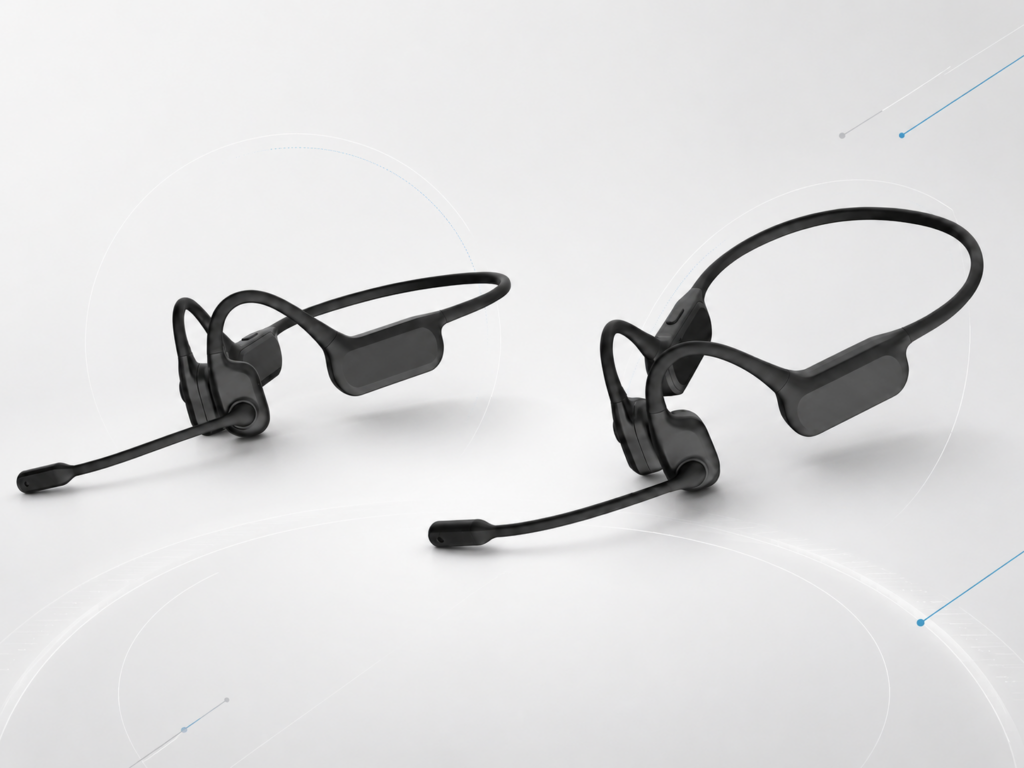
PTT01 was developed because a normal Bluetooth headset could not fully match the client’s scene.
The client needed a product that could support communication, not just music or phone calls.
That is an important difference.
A consumer Bluetooth headset is usually judged by music sound, call quality, design, and battery life.
A work communication headset is judged by whether staff can use it again and again during the working day.
It must be reliable.
It must be simple.
It must be comfortable.
It must fit the team workflow.
It must help the user hear messages without losing awareness of the store.
Why open-ear mattered
Open-ear design was not chosen only for style.
It was chosen because store staff need awareness.
They cannot block their ears completely.
They need to hear customers, nearby staff, alarms, machines, and background changes.
At the same time, they also need to hear team messages through the headset.
This creates a balance problem.
If the headset is too open, the user may not hear the message clearly.
If the headset blocks too much, the user may lose contact with the store.
The open-ear structure had to support both sides.
Why push-to-talk mattered
Push-to-talk is useful in team scenes because it supports quick and controlled communication.
Staff do not always need a full phone call.
They often need short messages, quick replies, or task updates.
In a noisy store, this kind of communication must be fast and simple.
PTT01 was designed around this kind of use.
It had to support practical team communication, not only personal listening.
| Product Direction | Reason |
| Open-ear design | Keeps environmental awareness |
| Push-to-talk use | Supports fast team messages |
| Bluetooth hardware | Supports wireless work movement |
| Microphone-focused development | Improves speech pickup in noisy scenes |
| Wearable structure | Makes long shifts more comfortable |
PTT01 also had to match the client’s existing communication system.
That made the project more serious.
The headset was not only a device worn on the ear.
It became the user-side terminal of a larger communication solution.
Why Was a Ready-Made Headset Not Enough?
A ready-made headset can be useful for fast sales.
But it cannot solve every complex workplace communication problem.
A ready-made headset usually has fixed structure, fixed acoustic layout, fixed microphone position, fixed software behavior, and fixed connection logic.
That is fine when the buyer’s needs are close to the existing product.
But this case was different.
The client had its own intercom system.
The product had to match a specific work scene.
The user needed open-ear comfort.
The microphone had to perform under noise.
The project also needed clear quality standards before trial production.
These requirements could not be solved by changing only the logo or packaging.
The gap between “a headset” and “a communication tool”
Many buyers say they need a headset.
But what they really need is a tool for a certain work process.
This is the gap.
A headset is a product.
A communication tool is part of a system.
For PTT01, the system included people, stores, noise, movement, intercom logic, microphone pickup, Bluetooth behavior, and production stability.
If one part was weak, the whole use experience could fail.
For example, a headset may sound fine in a quiet room.
But in a game hall, the user may face music, machines, customer voices, and other staff speaking nearby.
A microphone may work well during a close-mouth test.
But if the user turns the head or speaks while walking, the result may change.
A Bluetooth connection may work in one test setup.
But it still needs to match the client’s real communication device.
That is why ready-made development was not enough.
| Ready-Made Headset Limit | PTT01 Project Need |
| Fixed microphone layout | Pickup had to match noisy team talk |
| Fixed wearing structure | Comfort had to support long shifts |
| Fixed connection behavior | Product had to match the client’s intercom system |
| Fixed user logic | Push-to-talk workflow had to be considered |
| Limited scene testing | Real noisy scenes needed repeated review |
This is why the project had to move into joint development.
The client brought microphone experience and communication system knowledge.
Our team brought open-ear hardware, Bluetooth design, product structure, and production engineering.
The value came from combining both sides.
How Did We Turn the Requirement Into an Engineering Project?
The first step was not drawing a product.
The first step was turning the customer’s scene into engineering language.
A custom headset project cannot depend on a few simple words like “clear sound” or “good noise reduction.”
Those words are easy to say, but hard to build.
The team needed to define what “clear” meant in this scene.
Clear for whom?
Clear in what noise?
Clear at what speaking distance?
Clear during walking or standing?
Clear through which system?
These questions helped turn a business request into product requirements.
From scene language to product language
The client’s original need was based on work scenes.
They wanted a headset for noisy places, multi-person communication, clear listening and pickup, and comfortable wearing.
The engineering team had to turn that into product work.
That meant reviewing structure, microphone position, Bluetooth connection, sound output, button use, power layout, PCBA, antenna, housing, and production process.
This is where many custom projects fail.
The buyer talks in scene language.
The factory talks in product language.
If no one translates between them, the project becomes slow and unclear.
In this case, the project used repeated discussions, sample reviews, problem lists, internal checks, and customer feedback to keep both sides aligned.
What had to be defined
Before the project could move forward, several points had to be made clear.
| Definition Area | Key Question |
| Use scene | Where will the headset be used most often? |
| User behavior | Will staff walk, talk, serve, and move during use? |
| Listening need | What messages must the user hear clearly? |
| Pickup need | What voice quality does the team need to hear? |
| Connection need | How should the headset work with the intercom system? |
| Wearing need | How long will staff wear it each day? |
| Quality need | What result is acceptable before production? |
This process made the project more controlled.
It also helped both sides avoid guessing.
The client did not only say what they wanted.
They helped review whether the result matched their microphone and communication expectations.
Our side did not only build a headset shell.
We worked on turning the scene into a wearable open-ear communication product.
That is the real meaning of joint development.
What Did We Test and Improve During Development?
The development process included repeated testing, issue tracking, and engineering updates.
PTT01 went through many rounds of review before moving toward trial production planning.
The project did not move in a straight line.
Real development rarely does.
A new headset for a special work scene usually needs repeated testing and correction.
This is why problem tracking was important.
During development, both teams reviewed sample feedback, microphone behavior, wind noise, sound prompts, connection behavior, structural parts, PCBA layout, antenna design, and production readiness.
This kind of work is not always visible to the final buyer.
But it is what decides whether a product can move from sample to production.
Problem lists made the project more real
A problem list is not a negative sign.
It is a sign that the project is being managed.
In a serious development project, problems should be found early, written down, assigned, tested, and reviewed.
If a product has no visible problems during development, that does not always mean it is perfect.
Sometimes it means the team has not tested deeply enough.
For PTT01, repeated problem tracking helped both sides keep the project moving.
It created a shared record of what had been tested, what needed to be improved, and what had already been solved.
Key engineering review areas
| Test or Review Area | Why It Mattered |
| Microphone pickup | To check whether speech stayed clear in noisy scenes |
| Wind noise | To reduce interference when users moved or worked near airflow |
| Sound prompts | To make user operation easier and clearer |
| Bluetooth connection | To support stable wireless communication |
| Antenna design | To reduce connection risk inside a compact headset |
| PCBA layout | To fit the headset structure and support production |
| Button usability | To support simple push-to-talk operation |
| Structural design | To improve wearing comfort and assembly stability |
| Material and housing | To balance comfort, durability, and appearance |
| Production process | To prepare the product for trial production |
This development work showed one important point.
PTT01 was not only tested as a sound device.
It was tested as a full communication product.
That means the product had to work from several angles at the same time.
The microphone had to pick up the voice.
The speaker had to deliver the message.
The Bluetooth system had to stay stable.
The structure had to remain comfortable.
The buttons had to be usable.
The production process had to be controllable.
A good result in one area was not enough.
The whole product had to be ready for the next stage.
Why Did Microphone Experience Matter So Much?
The client’s microphone background made the project more demanding.
It also made the project more valuable.
A microphone is not just a small part inside a headset.
In a communication headset, the microphone is one of the most important user experience points.
If the team cannot hear the speaker clearly, the product fails.
This is especially true in noisy stores and game halls.
In a quiet room, many microphones can sound acceptable.
But in a noisy work scene, weak microphone design becomes obvious.
The voice may sound far away.
The voice may become thin.
Background noise may cover speech.
Wind noise may enter the microphone.
The user may turn the head and change the pickup result.
This is why the Japanese client’s microphone experience mattered.
They could judge the product from a more professional pickup angle.
The project could not stop at “has a mic”
Many basic headset descriptions only say the product has a microphone.
That is not enough for this case.
The question was not whether PTT01 had a microphone.
The question was whether the microphone could support real team communication in noisy work scenes.
That required testing and review.
It also required discussion between microphone experience and headset hardware design.
A microphone position may look good on paper, but it still has to fit the structure.
A structure may look clean, but it may affect pickup.
A wind protection idea may help noise, but it may affect voice clarity.
Every choice needed balance.
Microphone and open-ear design had to work together
Open-ear products create a special design challenge.
Because the ear is not sealed, the user still hears the outside world.
This is good for awareness, but it also means the headset must deliver enough communication clarity.
At the same time, the microphone must focus on the user’s voice without making the product heavy or uncomfortable.
This is where the project became more than normal hardware work.
It needed microphone thinking, acoustic thinking, structure thinking, and user-scene thinking.
That is why the project needed both sides.
The client helped define and judge the voice pickup needs.
Our team helped turn those needs into a wearable Bluetooth open-ear headset.
The final value came from the combination.
How Did Bluetooth, Intercom, and Hardware Work Together?
PTT01 had to work as part of a communication chain.
It was not developed as a normal personal audio device.
The client already had its own intercom system.
So PTT01 had to support that system instead of working only as a standalone headset.
This changed the design logic.
For a normal headset, the user may only connect to a phone, listen to music, or answer calls.
For PTT01, the headset had to support team communication behavior.
It had to work with the customer’s communication device.
It had to support practical use during work.
It had to make operation simple enough for staff.
The headset became a wearable terminal
This is the best way to understand PTT01.
It was not only an ear-worn audio product.
It was a wearable terminal for team communication.
That means the product had to manage several layers at once.
| Layer | Role in the Product |
| Bluetooth layer | Supports wireless connection and movement |
| Intercom layer | Matches the client’s team communication system |
| Microphone layer | Captures the user’s voice |
| Speaker layer | Delivers clear listening |
| Structure layer | Keeps the headset comfortable and stable |
| Production layer | Makes the product repeatable in manufacturing |
Each layer affected the final experience.
If the Bluetooth behavior was unstable, the user would lose trust.
If the microphone result was weak, the team would miss messages.
If the speaker was not clear enough, the user would repeat instructions.
If the structure was uncomfortable, staff would stop wearing it.
If production could not control the result, mass production would become risky.
That is why the project needed system thinking.
Hardware work was not less important than sound work
Some people may think a microphone company only needs microphone support.
But a headset product needs much more.
PTT01 had to include PCBA design, antenna review, structure development, button layout, housing design, charging logic, sound prompts, battery space, and assembly planning.
These points may look small one by one.
But together, they decide whether the product can be used and produced.
A strong project must connect engineering details with user needs.
That is what we tried to do in this case.
What Had to Be Confirmed Before Trial Production?
Before trial production, the most important work was alignment.
Both sides had to confirm product functions, quality standards, material readiness, and the trial review plan.
Trial production is not just making a small batch.
It is the bridge between design development and mass production.
If the team enters trial production with unclear standards, the trial result will be hard to judge.
One side may think the product passed.
The other side may think it still needs changes.
This is why the pre-trial production review was so important for PTT01.
The team needed to confirm what the product should do.
They also needed to confirm how both sides would judge the result.
Function definition had to be locked
Before trial production, the product function definition had to be clear.
That means the team had to agree on the key features and the expected user behavior.
For example, how the product should be used in team communication.
How the buttons should work.
How the sound prompts should guide the user.
How the headset should connect.
How staff should wear and operate it during work.
If these details were still unclear, trial production would create more questions than answers.
Quality standards had to be shared
Quality standards are not only factory standards.
In a joint development case, they must be shared standards.
The customer and the development team must know what is acceptable and what is not.
This includes sound, microphone performance, structure, appearance, operation, connection, and production consistency.
| Pre-Trial Item | Why It Had to Be Confirmed |
| Product function definition | To avoid unclear expectations during trial testing |
| Quality standard | To let both sides judge results in the same way |
| Material readiness | To reduce delays before trial production |
| Test plan | To check the right issues during the trial |
| Production process | To see whether the design can be built repeatedly |
| Review meeting | To decide what must improve before mass production |
After trial production, the next step is the trial review meeting.
That meeting checks the real output.
It also decides whether the project can move to material preparation and mass production planning.
This stage is very important.
It is where engineering work meets real manufacturing.
A product may look good as a sample.
But trial production shows whether it can be built with stable quality.
That is why the project did not stop after design development.
It moved toward a more serious production review process.
What Can Other Buyers Learn From the PTT01 Case?
The biggest lesson is simple.
A strong headset project should start from the work scene, not from a feature list.
Many buyers start by asking about battery life, Bluetooth version, price, certification, or packaging.
Those points are important.
But they are not the starting point for a complex communication headset.
The starting point should be the use case.
Where will the product be used?
Who will wear it?
How long will they wear it?
What noise will be around them?
What system must it connect to?
What message must be heard clearly?
What voice must be picked up clearly?
What level of comfort is required?
These questions decide the real product direction.
A better project brief helps everyone
A clear project brief saves time.
It helps the engineering team understand the buyer’s real need.
It also helps the buyer avoid choosing the wrong solution.
| Weak Brief | Better Brief |
| We need a headset | We need an open-ear PTT headset for noisy store staff |
| We need clear calls | Staff must speak clearly near customers and background music |
| We need Bluetooth | It must connect with our intercom system |
| We need comfort | Staff must wear it during long shifts |
| We need noise reduction | The microphone must support team talk in noisy scenes |
The second type of brief is much easier to develop.
It gives the product team useful direction.
It also shows which trade-offs are acceptable.
For example, if open-ear awareness is required, the product should not become a sealed earbud.
If team communication is the core need, microphone pickup should be more important than deep bass.
If the product must connect with an intercom system, system matching must be checked early.
Professional development needs patience
PTT01 took time because it was not a simple product.
The project included requirement definition, sample review, repeated problem lists, microphone testing, wind noise review, sound prompt discussion, PCBA and antenna work, structural refinement, customer feedback, internal review, and trial production planning.
This is what serious custom development often looks like.
It is not always fast.
But it is safer.
Fast development can be good when the product already exists.
But for a new communication product in a special scene, speed without validation can create risk.
The better goal is not only to make a sample.
The better goal is to make a product that can pass trial production and move toward stable mass production.
Conclusion
PTT01 shows how a real noisy-store communication need can become an open-ear PTT headset through joint development, repeated testing, and trial production planning.
FAQ
What is an open-ear PTT headset?
An open-ear PTT headset is a push-to-talk communication headset that does not block the ear canal.
It helps users talk with a team while still hearing the surrounding environment.
Why are open-ear headsets useful in noisy stores?
They let staff hear team messages and still stay aware of customers, alarms, and nearby activity.
This makes them useful for service and retail work.
Is PTT01 a normal Bluetooth headset?
No.
PTT01 was developed as an open-ear push-to-talk headset for noisy team communication, not only as a personal music or call headset.
Why does microphone design matter in retail communication?
Retail stores have background music, customer voices, movement, and machine noise.
A good microphone design helps the team hear speech more clearly in these real conditions.
Can a ready-made headset solve noisy store communication?
Sometimes it can, if the needs are simple.
But custom development is often needed when the headset must match an intercom system, special use scene, and long-shift wearing needs.
What should buyers prepare before developing a custom headset?
Buyers should define the use scene, user behavior, noise environment, connection system, wearing time, voice pickup needs, and quality standard.
This helps the project move faster and safer.
Why is trial production important for a headset project?
Trial production checks whether the design can be built with stable quality.
It helps find problems before mass production starts.
What makes PTT01 different from a normal call headset?
PTT01 was built for noisy team communication, open-ear awareness, push-to-talk use, and intercom system matching.
A normal call headset is usually designed for personal calls.