

ALOVA · ENGINEERING INSIGHTS
Choose the contact interface and evidence—not just the earphone shape.
Quick answer: Cartilage conduction applies vibration to outer-ear cartilage; bone conduction uses skull vibration. Their sound pathways differ. For an OEM project, compare the finished device’s fit, output and intended use before choosing a platform. An ear-clip shape alone does not identify the technology. [1]
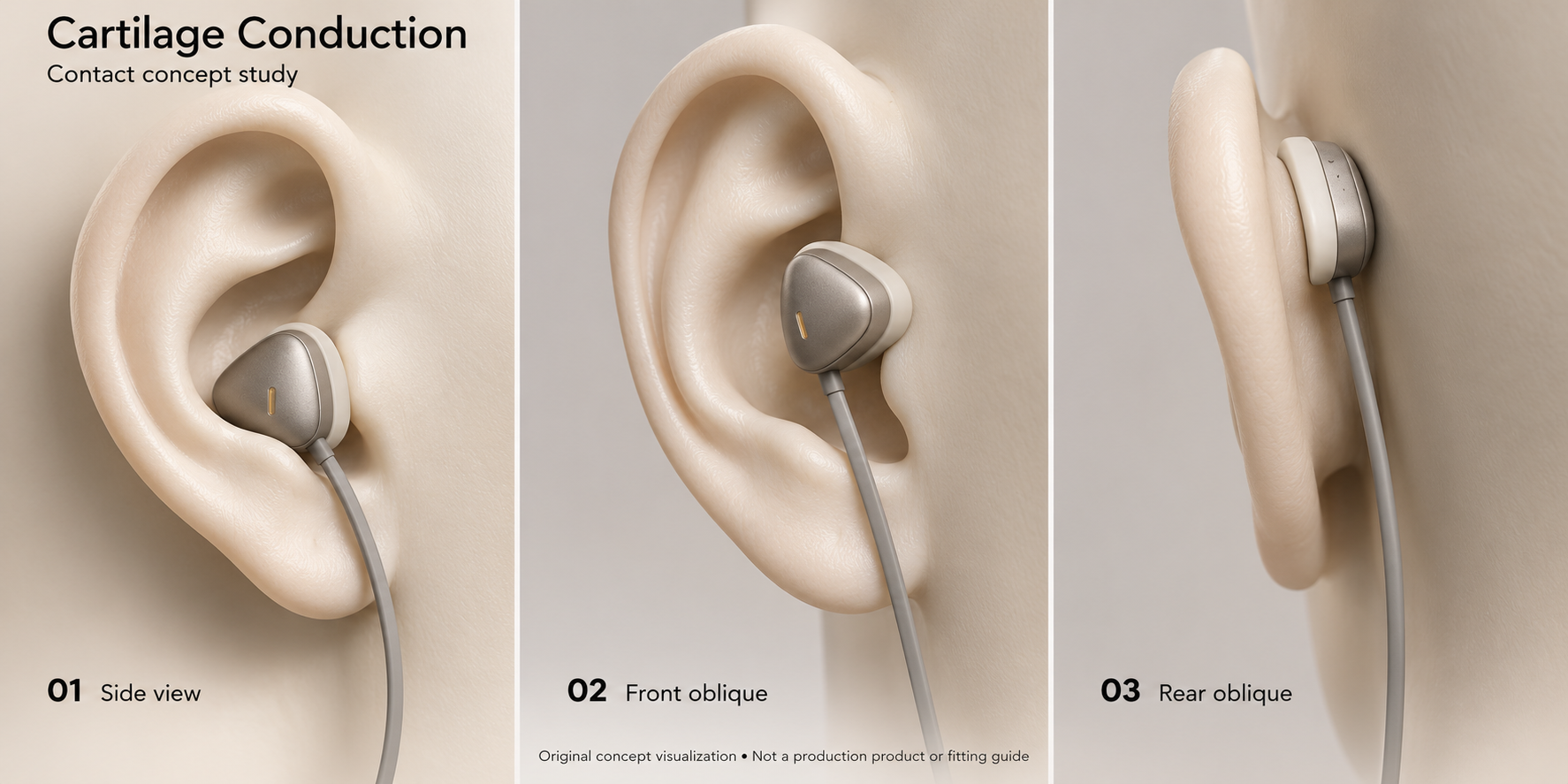
What is the practical difference?
In an open, functioning ear, vibrating cartilage can generate sound inside the ear canal, which then travels through the eardrum and middle ear. Cartilage conduction should therefore not be described as universally bypassing the eardrum. Other pathways can also contribute. [1]
| Design question | Cartilage conduction | Bone conduction |
|---|---|---|
| Where is vibration coupled? | Outer-ear cartilage; specify the actual contact site. | Through the device’s skull-coupling interface. |
| What needs checking? | Contact area, ear-shape variation and canal clearance. | Coupling position, retention and vibration sensation. |
| Which is better? | Neither label establishes a better finished product. Evaluate the intended task with matched test conditions. | |
ALOVA’s engineering recommendation: Photograph the wearing position before comparing sound. A change in contact can change what is being evaluated; do not treat fit as an appearance decision only.
Technology origin and ALOVA’s role
Hiroshi Hosoi of Nara Medical University discovered cartilage conduction in 2004. PASONA CCH Sound supplies cartilage-conduction transducers and licenses related technology. [2]
ALOVA 奈听 develops and manufactures hearing aids, assistive-listening devices and cartilage-conduction sound amplifiers for brand partners. Our project scope concerns the finished device: mechanical integration, electronics, acoustic tuning, usability and manufacturing. A supplier’s component data does not establish the performance of a complete ALOVA model. Mentioning CCH Sound does not imply an authorized partnership or a confirmed component selection.
Four checks before selecting an OEM sample
- Fit and repeatability. Record the contact location, retention method and wearing stability. Repeat placement across representative ear shapes; note pressure discomfort and interference with glasses.
- Output and leakage. Document the transducer, firmware, test signal and measurement setup. Compare leakage at a matched listening reference—not the same volume-slider percentage.
- The intended task. Separate music, calls and listening assistance. Hearing-benefit claims need evidence for the finished device and intended users; a published mechanism study is not a product validation.
- Production consistency. Agree a reference sample, measurable acceptance limits and change control. Review the effect of changes to the contact material, transducer mounting or firmware.
These are proposed purchasing checks, not a claim that a particular ALOVA model has completed every test.
Two questions buyers often ask
Is every ear-clip device cartilage conduction?
No. Ear clip describes how a device is worn. Ask the supplier to identify its sound-delivery mechanism and provide supporting measurements.
Does either technology guarantee clearer speech or no leakage?
No. Request results for the exact model, wearing conditions and intended users. Technology names and DSP channel counts alone are insufficient evidence.
Bring a clear evaluation brief
Share your target users, market, intended task, preferred wearing format and sample requirements. ALOVA can discuss an OEM/ODM development scope around those needs.